

Reluctance to adopt new-age marketing tools due to ethical concerns in business: Healthcare groups are hesitant to use new marketing tools, such as media or AI, because they are concerned about moral issues. Reluctant to adopt new-age marketing tools, they want to ensure they are marketing in a way that’s safe and right for patients. From Digital Direct Rule, Healthcare groups like yours are hesitant to adopt new-age marketing tools like social media or AI-driven analytics. If you feel hesitant to use new tools, then this is because you’re concerned about ethics and moral issues. In this article, we will discuss this in detail.
Reluctance to adopt new-age marketing tools due to ethical concerns
This attention helps ensure that patient welfare and ethical practices stay important in marketing decisions. Do you want me to help with anything else related to Digital Direct Rule or healthcare marketing? Organizations are hesitant to adopt new-age marketing tools like social media, AI-driven analytics, or targeted advertising due to ethical concerns. These concerns include protecting patient privacy, ensuring accuracy of health information, avoiding exploitation of patients, and maintaining transparency and trust. This cautious approach can lead to slower adoption of new marketing tools, but it prioritizes patient welfare and ethical practices.
Introducing new technologies and processes in marketing operations can meet resistance from team members used to traditional methods. Fear of change and lack of proper training can slow adoption, leading to inefficiencies and missed opportunities for improvement.
Challenges facing to adoption of new marketing Tools
When it comes to adopting new-age marketing tools due to ethical concerns, some challenges marketers face include:
- Balancing effectiveness and ethics: Wanting to use effective tools while addressing ethical worries
- Navigating data privacy concerns: Ensuring user data is safe
- Addressing algorithm bias: Making sure AI decisions are fair
- Maintaining transparency: Being clear about marketing practices
- Overcoming hesitation: Deciding to adopt despite ethics concerns
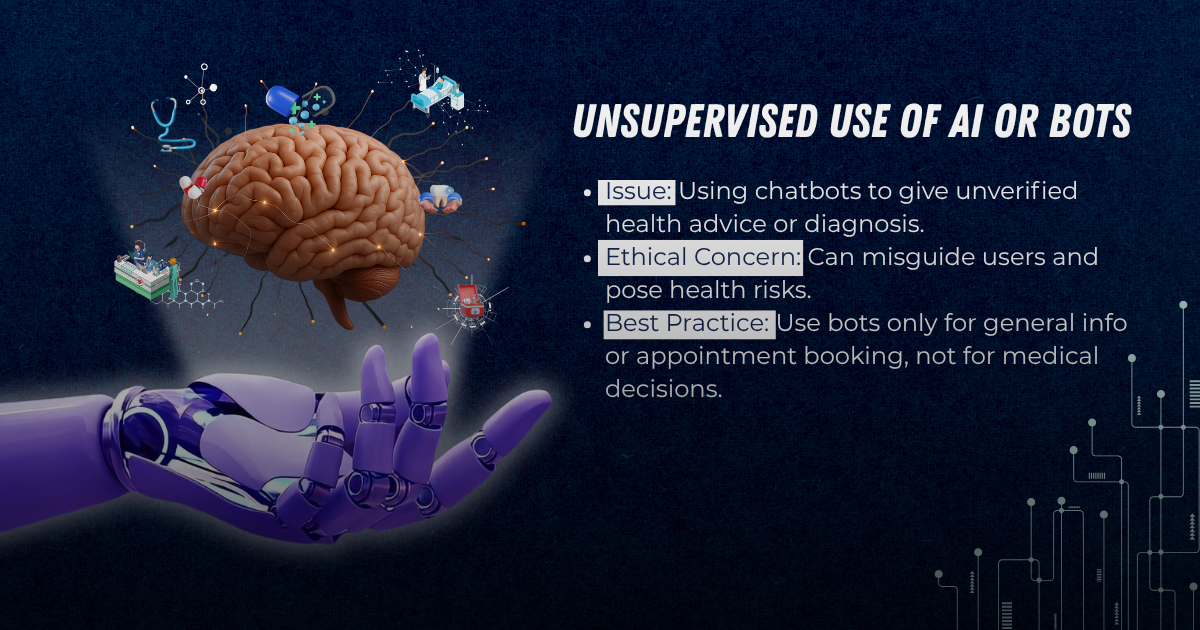
Unsupervised Use of AI or Bots
Unsupervised learning in artificial intelligence is a type of machine learning that learns from data without human supervision. Unlike supervised learning, unsupervised machine learning models are given unlabeled data and allowed to discover patterns and insights without any explicit guidance or instruction.
Digital Direct Rule Company helps candidates in the digital world. This world has seen three generations of chatbot technology. The first two chatbot generations were based on a predefined set of rules and supervised machine learning models. While the first succumbed to meaningless responses for undefined questions, the second required extensive data labeling for training.
Reluctance to adopt new-age marketing tools due to ethical concerns. Users became frustrated with chatbot responses and attributed the failure to over‑promising and under‑delivering. While it might seem easy at first, as the inflow of conversations and data grows, it becomes dreadful. Also, this requires a supervisor, an expert who is constantly tagging the conversation data to a chatbot. Hence, it becomes expensive after a while to train chatbots using this model. And that too when the nature of user queries is only going to vary more with time.
Hesitate to adopt new-age marketing tools due to ethical concerns. Issues:
Using chatbots to give health advice or diagnosis without checking is a big risk. Chatbots might give wrong or unverified information about health. This can lead to people getting the wrong treatment or making bad health decisions. Patient safety could be hurt if they follow the wrong advice.
Chatbots are okay for giving general health information or pointing people to helpful resources. But for actual diagnosis or treatment advice, healthcare professionals need to check and confirm things. This way, patients get safe and accurate information about their health.
Limited Understanding of Complex Cases: Chatbots in healthcare might have trouble dealing with:
Complicated health problems: Chatbots might not handle tricky or unusual cases well. Nuances in symptoms: Chatbots could miss subtle details in symptoms or patient history
Transparency: Companies should be open about their marketing practices. This means telling people about sponsored content, connections with others, and how they use customer data.
Misleading Ads: Making ads that trick or lie to people is bad. It can get companies into legal trouble.
Using Customer Data: Using customer info to group people (segmentation) based on things like money or race can lead to treating some people unfairly. This is a big ethics issue. Chatbots can’t match human empathy or emotional support in tough situations
Ethical Concerns of Reluctance to Adopt New-Age Marketing Tools:
Many marketers are hesitant to use new marketing tools like AI because of worries about data privacy, algorithm bias, and transparency. These concerns make them unsure about using AI-powered personalization since it raises questions about user consent and data security. But Reluctance to adopt new-age marketing tools due to ethical concerns can misguide users and pose health risks. If they give wrong health information, it can lead to bad health choices.
Don’t get symptoms right: Might miss important details about the patient cases. Lead to bad outcomes. Reluctance to adopt new-age marketing tools due to ethical concerns. Users might hurt their health themselves with bad advice. The hesitation in healthcare organizations needs to find a balance between using effective marketing tools and upholding ethical standards. This balance helps them engage with patients while maintaining trust and integrity.
Best Practice of ethics concern in new marketing tools:
Use bots only for general info or appointment booking, not for medical decisions. The most common ways AI chatbots are used in health care include: 24/7 availability with immediate responses, which reduces or eliminates the need for patients to wait for office hours to speak to a health care provider. Automation of repetitive administrative tasks to free up time for direct patient interaction.
Chatbots are being used more in mental health. People with mental health issues can use chatbots to talk about their feelings and experiences anytime they need support. This lets them deal with issues right away instead of waiting to talk to a healthcare provider.
Building trust and credibility: Ethical marketing establishes trust between brands and consumers. When companies uphold ethical standards, it fosters credibility, encouraging consumers to believe in the brand’s values and promises.
Long-term brand reputation: Ethical marketing initiatives significantly shape a positive brand reputation. Brands that consistently demonstrate ethical behavior tend to create lasting customer relationships, increasing loyalty and positive word-of-mouth marketing.
Conclusion
In this article, we discussed the Reluctance to adopt new-age marketing tools due to ethical concerns: Healthcare groups are hesitant to use new marketing tools, such as media or AI, because they are concerned about moral issues.
FAQs
1. How are bots used in healthcare?
Ans- Chatbots offer various applications in the healthcare sector, from providing information on symptoms and treatments to scheduling appointments and medication reminders, but their main focus till now is within mental health, screening, and public health, according to Afsahi et al
2. How are bots changing the medical industry?
Ans – AI chatbots in healthcare are changing how patients connect, helping with office work, and making care more reachable. Chatbots can schedule appointments, check symptoms in real-time, and help healthcare workers by doing routine tasks so staff can focus on patients. This makes healthcare more efficient and helps healthcare providers handle less work.
3. Do bots and AI have the same thing?
Ans – AI agents and bots are both automated tools, but they differ in how they operate, their complexity, and their applications. Bots are simple, rule-based programs designed to perform repetitive tasks without learning or adapting.